Emergency Smoke Damage Restoration in Macomb
Emergency smoke damage restoration in Macomb and surrounding areas. Insurance billing accepted. Call (586) 580-0197.
Smoke damage emergency in Macomb? Call now for emergency service. Our crew responds fast to stop smoke and soot damage from spreading.
The smell that won’t leave, and the damage you can’t always see
Smoke from a house fire doesn’t stop moving when the flames go out. Within hours, acidic soot particles migrate through HVAC ducts, settle into wall cavities, and bond chemically to painted surfaces, fabrics, and wood grain. The visible char is only part of the problem. The oily film coating your kitchen cabinets, the sharp odor embedded in closet clothing three rooms from the fire, the discoloration creeping across ceiling drywall, those are the signatures of smoke damage, and they get harder to reverse the longer they sit.
What smoke damage restoration actually involves
Smoke damage restoration is a multi-phase process that addresses three distinct problems at once: soot deposits on surfaces, odor molecules absorbed into porous materials, and residual contamination inside mechanical systems.
Soot is not uniform. A kitchen grease fire produces a wet, sticky protein residue that smears if wiped incorrectly. A structural fire burning synthetic materials like plastics and foam generates dry, powdery soot that travels farther and penetrates deeper. Each type requires a different cleaning chemistry and a different hand pressure. Using the wrong approach on protein soot, for instance, can permanently set the stain into drywall or cabinetry.
Odor removal goes beyond surface cleaning. Smoke molecules are small enough to penetrate latex paint, drywall paper, and wood fibers. Thermal fogging and hydroxyl generation are the two primary technologies used to neutralize odor at the molecular level rather than masking it. In severe losses, affected drywall or subfloor sections may need to be removed entirely because no surface treatment will reach the contamination depth.
HVAC systems deserve specific attention. Smoke pulled through return vents during a fire can coat ductwork, the air handler, and the evaporator coil with fine particulate. Without cleaning those systems, every time the furnace or air conditioning runs, it redistributes smoke residue through the entire living space.
Timeline varies with severity. A single-room smoke event with limited structural involvement may be restorable in two to four days. A whole-house loss with heavy synthetic soot and saturated contents can run two to three weeks before the space is ready for reconstruction.
Our process
-
Soot characterization and scope assessment. Before any cleaning begins, the type of soot present is identified, protein, wet synthetic, dry powdery, or a combination. This determines which cleaning agents, tools, and containment measures are appropriate. Affected zones are mapped, and a written scope of work is produced.
-
Containment and HVAC isolation. To prevent cross-contamination, HVAC registers are sealed and the system is locked out. Negative air pressure may be established in heavily affected areas using air scrubbers equipped with HEPA filtration to capture airborne particulate during cleaning.
-
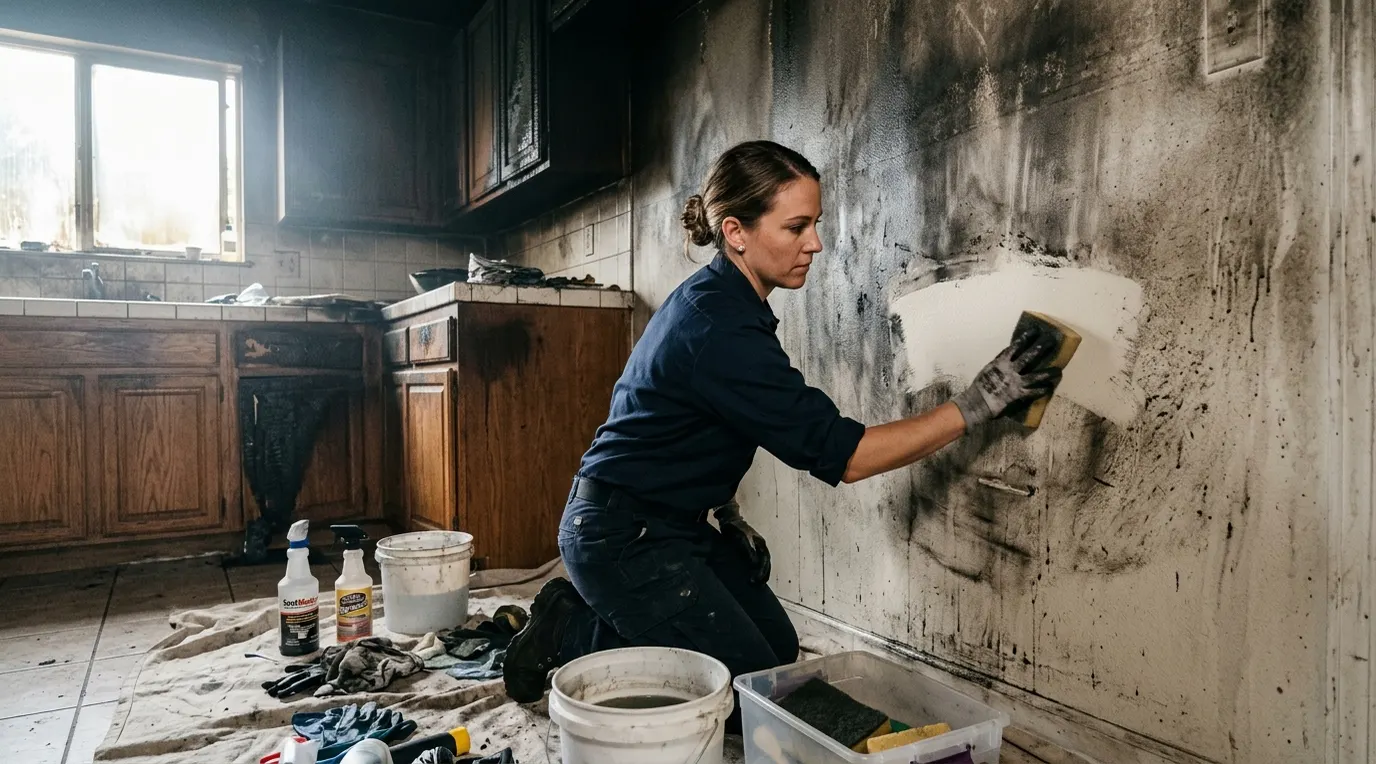
Dry soot removal and surface cleaning. Loose soot is removed with dry chemical sponges before any wet cleaning agent is applied. Applying liquid to dry soot first drives it deeper into the substrate. After dry removal, appropriate cleaning solutions are used surface by surface, alkaline cleaners for most soot, enzymatic or protein-specific agents for cooking residue.
-
Thermal fogging and odor neutralization. Thermal foggers disperse a deodorizing agent in a particle size small enough to penetrate the same pathways smoke used. This is followed by hydroxyl or ozone treatment in unoccupied spaces to neutralize residual odor compounds at the molecular level. Ozone treatment requires the space to be vacated by people and pets.
-
Contents evaluation and pack-out (when needed). Furniture, clothing, documents, and personal items are evaluated on-site. Items that can be restored are inventoried and transported to a controlled cleaning facility. Items that cannot be restored are documented for the insurance claim before disposal.
What separates a good smoke damage response from a bad one
The most common mistake in smoke damage cleanup is cleaning in the wrong sequence. Wiping soot with a wet cloth before dry-sponging it first is one of the fastest ways to permanently stain drywall or wood trim. A less experienced crew may also skip soot characterization entirely and apply a single cleaning product across all surfaces, producing inconsistent results and missed contamination.
HVAC systems are frequently undertreated or skipped. Adjusters reviewing a smoke claim will look for documentation that ductwork was inspected and cleaned, because a contaminated HVAC system is a liability that affects air quality long after the rest of the restoration is complete.
Odor masking is another red flag. Spraying a fragrance product over smoke-affected materials may suppress the smell temporarily, but it does not neutralize the underlying compounds. If a property still has a detectable smoke odor after restoration, the source was not fully addressed, and that typically means affected porous materials were left in place or the HVAC system was not cleaned.
Insurance adjusters also look for a detailed contents inventory. Undocumented items that are discarded during cleanup cannot be claimed. A thorough restoration firm photographs, lists, and categorizes every affected item before anything leaves the property.
What does smoke damage restoration cost?
Typical costs for smoke damage restoration depend heavily on the size of the affected area, the type of soot involved, and whether contents pack-out or structural repairs are required. Most homeowners pay somewhere in the ranges below for the restoration work alone, separate from any reconstruction.
| Scenario | Typical range |
|---|---|
| Single room, light soot, no contents pack-out | $1,500 - $4,000 |
| Single room, heavy synthetic soot with odor treatment | $3,500 - $7,500 |
| Multi-room loss, mixed soot types, partial pack-out | $7,000 - $18,000 |
| Whole-house smoke loss, full contents pack-out | $18,000 - $45,000+ |
| HVAC system cleaning (standalone) | $800 - $2,500 |
| Thermal fogging and odor neutralization (standalone) | $500 - $2,000 |
Every loss is different, and Flood Solutions inc provides a written scope of work before any work begins so there are no surprises. Homeowners insurance typically covers smoke damage restoration when the loss results from a sudden, accidental fire, including the cost of contents cleaning and temporary housing if the property is uninhabitable during the process.
Seasonal and regional considerations
Macomb County’s cold winters affect smoke damage restoration in a specific way. When a fire occurs in January or February and exterior temperatures are well below freezing, ventilating the structure to clear smoke odor is limited. Crews must rely more heavily on mechanical odor neutralization rather than fresh-air flushing, which can extend the treatment timeline. Tight home construction common in newer Macomb subdivisions also means smoke distributes more evenly through the structure via the pressure-balanced HVAC system, making duct cleaning a near-universal requirement rather than an occasional one.
In summer months, high humidity in Southeast Michigan can reactivate odor in materials that were not fully treated, particularly in older homes with plaster walls that absorbed more deeply. If a smoke-affected home sat closed up in July heat before restoration began, expect the odor assessment to be more involved.
Service area
Flood Solutions inc serves Macomb and the surrounding communities throughout Macomb County, including Sterling Heights, Clinton Township, Shelby Township, Chesterfield, New Baltimore, and Warren. The service-area pages for each city link back to this page for the full technical detail on smoke damage restoration services.
If you are dealing with smoke residue, post-fire smoke cleanup, or wildfire smoke cleanup in any of these areas, the process and the standards described here apply regardless of which city you are calling from.
Call (586) 580-0197 to begin smoke and soot removal. A technician will walk through the scope with you, document the affected areas, and give you a written plan before any work starts.
Services We Handle
- Commercial Fire & Smoke Damage
- Odor Control
- Smoke Odor Removal
- Soot and Smoke Damage
- Soot and Smoke Removal
- Soot Removal
Frequently Asked Questions
Does homeowners insurance cover smoke damage restoration?
What is the difference between protein soot and synthetic soot, and why does cleanup vary?
How long does smoke odor linger if the damage is not treated professionally?
Does smoke damage restoration include cleaning the HVAC system?
What should I do, and avoid doing, while waiting for the restoration crew to arrive?
Looking for the best smoke-damage-restoration company in Macomb?
Flood Solutions inc provides smoke-damage-restoration in Macomb, MI and the surrounding area, and has served local property owners since 1996. Customers rate us 4.4 out of 5 stars across 35 Google reviews. We answer calls 24/7 — call (586) 580-0197 for immediate help.
Need smoke-damage-restoration now?
We respond 24/7 across Macomb and surrounding MI cities.
Related Coverage
- Our Restoration Services
- Contact Flood & Fire Solutions
- Emergency Water Damage Restoration in Macomb
- Mold Remediation in Macomb
- Emergency Sewage Cleanup and Sanitization in Macomb
- Emergency Storm Damage Restoration in Macomb
- Emergency Flood Damage Restoration in Macomb
- Emergency Smoke Damage Restoration in Chesterfield
- Emergency Smoke Damage Restoration in Clinton Township
- Emergency Smoke Damage Restoration in Rochester Hills
- Emergency Smoke Damage Restoration in Shelby Township
- Emergency Smoke Damage Restoration in Sterling Heights
- Emergency Smoke Damage Restoration in Troy
- Emergency Smoke Damage Restoration in Utica
- Emergency Smoke Damage Restoration in Warren
- The Fire Damage Restoration Process, Explained