Large Loss and Catastrophic Response in Macomb
Large loss and catastrophic response in Macomb and surrounding areas. Insurance billing accepted. Call (586) 580-0197.
When the loss is too big for a single crew
A burst pipe in one bathroom is a containable problem. A fire that moves through a commercial roof, a flood that saturates three floors of an apartment building, or a storm that takes out an entire wing of a warehouse is something else entirely. Large loss and catastrophic response is a discipline of its own: coordinating multiple licensed trades simultaneously, producing documentation that satisfies large loss adjusters, and keeping a project moving when the scope is still expanding. When the scale of a loss outpaces a standard restoration crew, the gap between a competent response and an inadequate one shows up fast.
What large loss and catastrophic restoration actually involves
Catastrophic losses share a few defining characteristics: the affected area is large enough that sequential work creates unacceptable delays, the structural damage crosses multiple systems (HVAC, electrical, plumbing, envelope), and the documentation burden is significant enough that a single project manager cannot carry it alone.
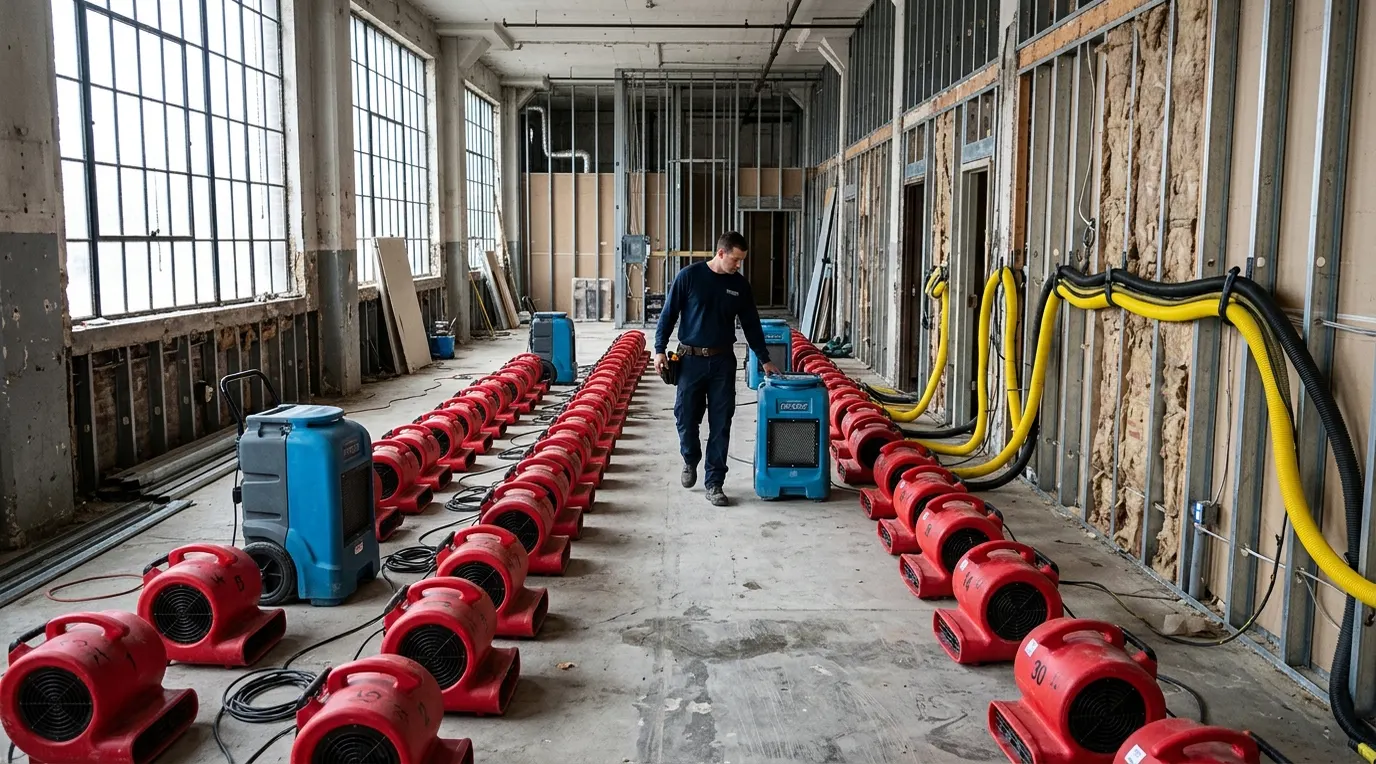
On a large loss, the work runs on parallel tracks. While one crew is performing emergency stabilization, such as tarping a compromised roof or extracting standing water from a ground floor, another is beginning structural assessment on upper levels. Industrial-grade drying equipment, commercial dehumidifiers, and high-volume air movers are deployed across the full footprint rather than room by room. Moisture mapping is conducted systematically and logged daily so that the drying record holds up under adjuster review.
For fire losses at this scale, soot characterization happens across multiple material types simultaneously. Protein residue from a commercial kitchen fire behaves differently than synthetic polymer soot from a warehouse, and the cleaning protocols differ accordingly. Odor mitigation at large loss scale often requires thermal fogging or hydroxyl generation across large open volumes rather than room-level treatment.
Documentation is not an afterthought. Every affected area is photographed, measured, and logged into a line-item estimate format that large loss adjusters and independent appraisers can audit. Scope creep is tracked in real time so that supplements are filed before work is completed, not after.
Our process
-
Emergency stabilization and perimeter control. The first priority is stopping active damage. That means boarding, tarping, water extraction, or utility isolation depending on the loss type. Access to the structure is controlled to protect both the property and the documentation chain.
-
Comprehensive damage assessment and scope development. A full structural and systems assessment is completed before restoration sequencing begins. This produces the initial scope of work that is submitted to the carrier. On catastrophic losses, this step is not compressed, because an incomplete initial scope leads to delayed supplements and project slowdowns.
-
Parallel trade coordination. Demolition, drying, structural repair, and specialty subcontractors are scheduled to run concurrently where the scope allows. A dedicated project manager tracks sequencing, inspections, and material lead times so that no trade is waiting on another unnecessarily.
-
Daily documentation and adjuster communication. Moisture readings, drying logs, photo documentation, and scope updates are produced on a daily cycle. Large loss adjusters and independent appraisers are given consistent access to current documentation. This keeps the claim moving and reduces the back-and-forth that stalls large projects.
-
Final inspection, clearance, and closeout. Before the project is closed, affected systems are tested, clearance inspections are completed where required, and a final documentation package is assembled for the carrier and the property owner.
What separates a good large loss response from a bad one
The most common failure on catastrophic losses is treating them like large versions of a standard job. A single project manager running sequential crews on a 40,000-square-foot loss will fall behind within the first week. By the time the scope is fully understood, the drying window has closed on areas that were not reached in time, and secondary damage has begun.
Large loss adjusters look for a few specific things when they review a claim. They want a daily drying log that shows readings taken at consistent locations, not a summary produced at the end of the dry-out. They want a scope that is line-itemed to Xactimate or a comparable estimating platform, not a lump-sum proposal. They want photo documentation that is organized by area and date, not a folder of unlabeled images. When these elements are missing, supplements are disputed and payment is delayed.
Another common problem is under-scoping the initial estimate to get a quick approval, then filing supplements piecemeal. Experienced large loss operators scope the full visible damage on day one, flag areas that require further investigation, and communicate that clearly to the adjuster upfront. It is a slower start but a faster finish.
What does large loss and catastrophic restoration cost?
Large loss restoration costs vary more than almost any other category in the industry because the scope is defined by the event, not by a standard room count. Typical costs run from low six figures for a contained commercial loss to several million dollars for a multi-structure or multi-floor catastrophic event. The table below reflects industry-typical ranges by scenario.
| Scenario | Typical range |
|---|---|
| Commercial water loss, single floor, clean water | $45,000 – $150,000 |
| Multi-floor commercial water or sewage loss | $150,000 – $600,000 |
| Large-scale commercial fire, partial structure | $300,000 – $1,200,000 |
| Catastrophic fire or storm, full structure | $1,000,000 – $5,000,000+ |
| Multi-building or campus-level event | Scoped individually |
Every loss is different, and Flood Solutions inc provides a written scope before any restoration work begins. Commercial property insurance and commercial general liability policies typically cover sudden and accidental catastrophic losses, though coverage limits, deductibles, and exclusions vary by policy and carrier.
Seasonal and regional considerations
Macomb County’s freeze-thaw cycle creates a predictable window for pipe failures and roof membrane damage, typically from late November through early March. Commercial flat roofs on older industrial and retail stock in the area are particularly vulnerable to ponding and membrane failure after heavy snow loads. Spring storm activity brings a second wave of large loss events, particularly wind-driven rain intrusion and basement flooding tied to overwhelmed municipal storm systems. Understanding these patterns matters for pre-loss planning and for interpreting the cause and origin of a loss during the claim process.
Service area
Flood Solutions inc handles large loss and catastrophic restoration in Macomb and throughout Macomb County, including Sterling Heights, Clinton Township, Shelby Township, Warren, Chesterfield, and surrounding communities. For multi-site losses that extend into Oakland or St. Clair County, reach out directly to discuss coordination.
When the scale of a loss exceeds what a standard crew can manage, the response has to match it. Call Flood Solutions inc at (586) 580-0197 to reach a project coordinator and begin the large loss assessment process.
Services We Handle
- Disaster Response
- Disaster Restoration
- Full Service Disaster Recovery
- Residential and Commercial Disaster Recovery
Frequently Asked Questions
Does commercial property insurance cover catastrophic restoration costs?
What do large loss adjusters specifically look for when reviewing a catastrophic restoration claim?
How is a large loss project managed differently from a standard restoration job?
What happens if the full scope of damage is not known on the first day?
How long does a catastrophic restoration project typically take from emergency response to completion?
Looking for the best large-loss-response company in Macomb?
Flood Solutions inc provides large-loss-response in Macomb, MI and the surrounding area, and has served local property owners since 1996. Customers rate us 4.4 out of 5 stars across 35 Google reviews. We answer calls 24/7 — call (586) 580-0197 for immediate help.
Need large-loss-response now?
We respond 24/7 across Macomb and surrounding MI cities.
Related Coverage
- Our Restoration Services
- Contact Flood & Fire Solutions
- Large Loss and Catastrophic Response in Chesterfield
- Large Loss and Catastrophic Response in Clinton Township
- Large Loss and Catastrophic Response in Rochester Hills
- Large Loss and Catastrophic Response in Shelby Township
- Large Loss and Catastrophic Response in Sterling Heights
- Large Loss and Catastrophic Response in Troy
- Large Loss and Catastrophic Response in Utica
- Large Loss and Catastrophic Response in Warren