
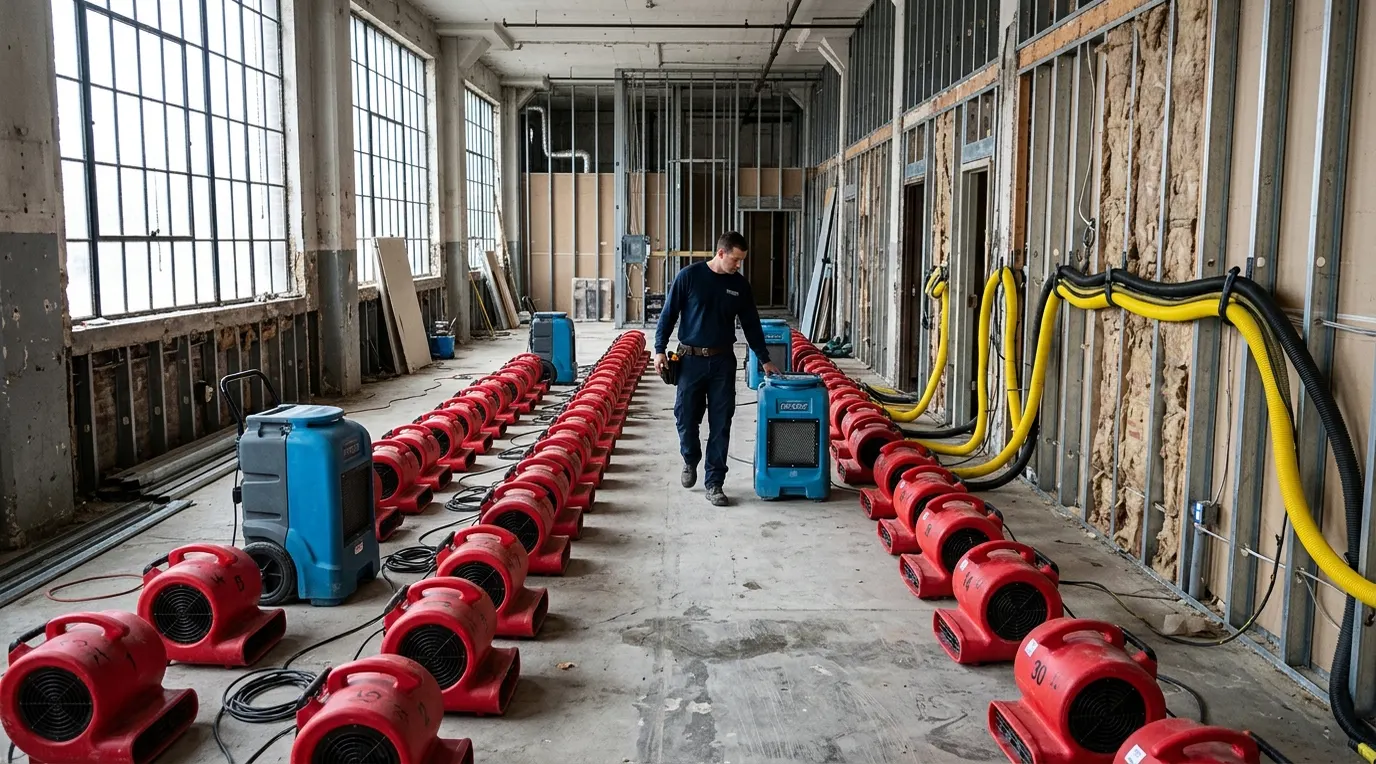
Large Loss and Catastrophic Response in Utica
Large loss and catastrophic response in Utica, MI. Insurance billing accepted. Call (586) 580-0197.
Our technicians are dispatched from our Macomb, MI headquarters and are typically on-site in Utica within 60 minutes of your call.
When a major loss strikes a commercial property or multi-unit building in Utica, the damage rarely waits for a convenient moment. Macomb County’s freeze-thaw cycle pushes hard on aging infrastructure every winter, and when a roof fails, a sprinkler system ruptures, or a fire tears through a mixed-use corridor, the scale of destruction can outpace what a standard restoration crew is equipped to handle. Flood Solutions Inc. has been coordinating large loss and catastrophic response since 1996, and the team based in nearby Macomb understands exactly what that kind of event looks like in this part of southeastern Michigan.
Why Utica Commercial Properties Face Elevated Catastrophic Loss Risk
Utica sits at the northern edge of Macomb County where suburban development from the 1970s and 1980s left a dense mix of strip retail, light industrial corridors, and multi-tenant office parks. Many of those buildings were constructed under older mechanical codes, with HVAC and suppression systems that have been patched and extended over decades rather than replaced wholesale. When one component fails under stress, the cascade can be fast and severe.
The regional climate adds pressure. Macomb County averages significant freeze events each winter, and the clay-heavy soils common throughout the area drain slowly, meaning a burst main or a storm surge from a heavy spring rain doesn’t just affect the surface. Water finds its way into slab joints, elevator pits, and below-grade utility rooms before anyone realizes the extent of the intrusion. For a large commercial property, that kind of hidden saturation can mean structural concerns, compromised electrical systems, and inventory losses that compound the longer the response is delayed.
What Large Loss Response Actually Looks Like in Utica
Catastrophic restoration at scale is not simply more of what a residential crew does. It requires parallel workstreams: emergency stabilization happening at the same time as documentation, with a dedicated project manager coordinating subcontractors, equipment logistics, and adjuster communication simultaneously.
For a large loss event in Utica, the process typically unfolds in these stages:
- Immediate stabilization: Stopping active water intrusion, boarding compromised openings, and deploying industrial drying equipment to the highest-priority areas before full scoping begins.
- Forensic documentation: Thermal imaging, moisture mapping, and photo documentation at a level that satisfies large loss adjusters and supports a defensible scope of loss.
- Scope development: Working directly with the carrier’s large loss unit or independent adjuster to build a line-item estimate that reflects actual local material and labor costs, not national averages.
- Phased restoration: Sequencing demolition, drying, rebuild, and systems restoration so that portions of a building can return to use while work continues elsewhere, minimizing business interruption.
For multi-story or multi-tenant properties, that sequencing matters enormously. A tenant who can reopen one floor while the adjacent wing is still under reconstruction represents a real difference in total economic loss.
Coordinating with Large Loss Adjusters and Carriers
Most standard property claims are handled by a local adjuster working a manageable caseload. A catastrophic loss, particularly one exceeding seven figures, typically triggers a different track: a dedicated large loss adjuster, sometimes a third-party independent, who is focused on scope accuracy and documentation quality above all else.
Flood Solutions Inc. has worked within that process long enough to know what large loss adjusters need before they ask for it. Moisture logs, equipment placement records, daily drying readings, and photo documentation tied to a room-by-room scope are standard practice, not an afterthought. That level of documentation also protects the property owner when disputes arise over what was affected and when.
For Utica properties with multiple tenants or lease agreements, the coordination layer extends further. Tenant business interruption claims, common-area liability questions, and landlord-tenant communication all intersect with the restoration timeline, and having a single point of contact who understands that complexity reduces friction significantly.
Reaching Utica from Macomb
Flood Solutions Inc. operates out of Macomb, which puts the team a short drive from Utica via M-59 or Hall Road. For large loss events, proximity matters less than mobilization capacity: the ability to arrive with the right equipment load and enough personnel to begin meaningful work immediately rather than making multiple trips.
For catastrophic events, the initial response includes a project manager, a lead technician crew, and the industrial equipment necessary to begin stabilization. Coordination with local utilities and the City of Utica’s building department for any required permits is handled as part of that early-phase work.
Local Note
Utica’s commercial corridors along M-59 include a concentration of buildings with flat or low-slope membrane roofs installed in the 1980s and 1990s. Those roofs have a known failure pattern: the membrane separates at seams during ice damming events, allowing water to pool on the deck and migrate inward along structural seams before it ever shows up as a ceiling stain. By the time a facility manager notices a drip, the insulation board and decking above may already be saturated across a much larger area than the visible damage suggests. Thermal imaging on the roof deck is a standard first step on any large loss event in this type of construction, and it consistently reveals affected areas two to three times larger than the initial visual inspection.
If a major loss has hit your Utica property, call Flood Solutions Inc. at (586) 580-0197. The sooner the documentation and stabilization begin, the more control you retain over the outcome.
Serving Utica from our Macomb headquarters — ★ 4.4 · 35 Google reviews
“Very knowledgeable and friendly employees. I had a flooded crawl space that I couldn't take care of myself. But Louis and his crew talked me through the whole process and then finished the job quickly and thoroughly.” — Chuck, October 2025Read our reviews on Google →
large-loss-response in Utica: Service Coverage
Frequently Asked Questions
How fast can you arrive for large-loss-response in Utica?
How does Flood Solutions Inc. handle the initial response for a large loss event along Utica's M-59 commercial corridor?
Utica has a lot of 1970s and 1980s commercial buildings. Does older construction change how a catastrophic loss is scoped?
What documentation does a large loss adjuster typically require for a Utica commercial property claim?
Can restoration work be phased so parts of a Utica commercial property stay operational during a large loss recovery?
Does the freeze-thaw cycle in Macomb County affect how quickly a large loss needs to be stabilized?
Will my homeowners insurance cover large-loss-response in Utica?
large-loss-response response in Utica
Most Utica calls see a technician on-site within 60 minutes from our Macomb headquarters.