Industrial Restoration in Clinton Township
Industrial restoration in Clinton Township, MI. Insurance billing accepted. Call (586) 580-0197.
Our technicians are dispatched from our Macomb, MI headquarters and are typically on-site in Clinton Township within 60 minutes of your call.
Clinton Township’s industrial corridor along the M-59 and Hall Road corridors hosts a dense mix of warehousing, light manufacturing, and distribution operations, facilities where a burst sprinkler line, a roof drain failure, or a smoldering electrical panel doesn’t just damage property, it stops production. Industrial losses at this scale move faster and cost more than residential ones, and the restoration approach has to match that pace. Flood Solutions inc has been working commercial and industrial losses in Macomb County since 1996, and the specific conditions here, freeze-thaw cycles, aging infrastructure in older industrial parks, and the sheer floor-plate size of many facilities, shape how every job gets planned.
Why Clinton Township Industrial Facilities Face Distinct Restoration Risks
Macomb County sits in a climate band where ground temperatures can swing dramatically between November and March. For industrial buildings, that means roof drains and overhead sprinkler mains are exposed to repeated freeze-thaw stress. A fitting that holds through five winters can fail in the sixth, releasing hundreds of gallons across a concrete production floor before anyone arrives for the morning shift.
Older industrial parks in the township, particularly those developed in the 1970s and 1980s along the M-59 corridor, frequently have flat or low-slope roofing systems that have been patched and re-patched over decades. When those roofs fail during a heavy Lake Erie-influenced snow event, water doesn’t just enter at one point; it migrates laterally under the membrane and surfaces in unexpected places inside the building, sometimes far from the visible ceiling stain. Tracing the actual moisture boundary in a 60,000-square-foot warehouse requires thermal imaging and moisture mapping, not a visual walk-through.
Fire losses in manufacturing environments carry an additional layer of complexity: smoke and soot from industrial materials, rubber, plastics, coatings, and lubricants, behave differently than smoke from a residential kitchen fire. The residues are oilier, they penetrate HVAC ductwork aggressively, and they can contaminate inventory and equipment far beyond the fire’s origin point.
Our Industrial Restoration Process in Clinton Township
Every industrial loss starts with a scope assessment that accounts for operational continuity. Before any equipment rolls in, the team identifies which areas of the facility can be isolated and which must stay accessible, a question that matters differently in a cold-storage warehouse than in an active stamping plant.
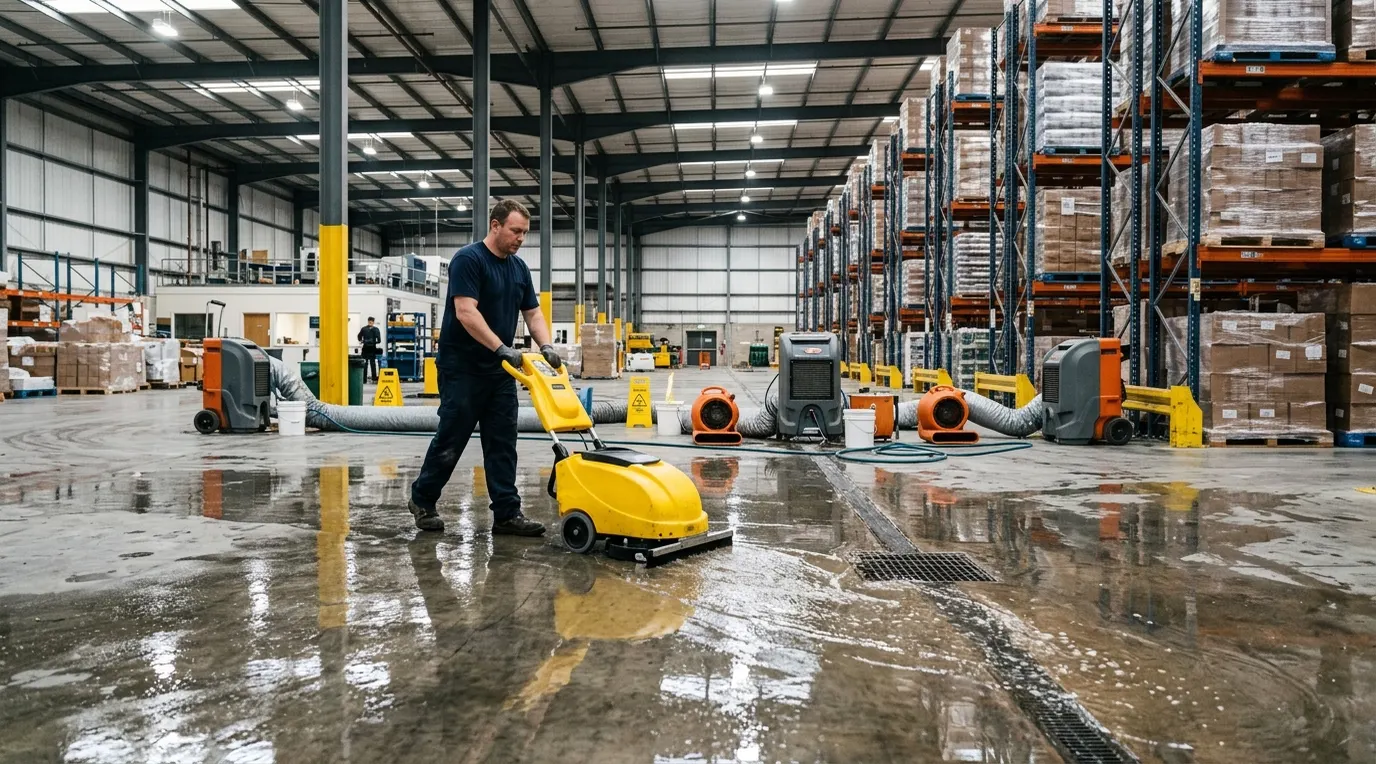
For water losses, the process follows a structured sequence: emergency extraction to remove standing water from drains, trenches, and low points; deployment of commercial-grade desiccant or LGR dehumidification equipment scaled to the cubic footage involved; and daily moisture mapping to track drying progress against a documented baseline. Concrete slabs in industrial settings hold moisture longer than wood-frame assemblies, and drying timelines are set accordingly rather than estimated by feel.
For fire and smoke losses, the scope includes a full inventory of affected materials, including contents, racking systems, and mechanical equipment, before any cleaning begins. Soot that has settled on machined surfaces or electrical panels requires a different protocol than soot on painted block walls, and those decisions are made room by room.
Throughout the project, documentation is maintained in a format that supports insurance carrier review and, where applicable, OSHA recordkeeping requirements for the facility.
Reaching Clinton Township from Macomb
Flood Solutions inc is headquartered in Macomb, which puts Clinton Township facilities within a practical service radius via Hall Road (M-59) and North River Road. Industrial parks along the township’s southern and central zones are accessible without navigating downtown congestion, which matters when equipment trailers and desiccant units need to reach a loading dock quickly. Scheduling and dispatch can be reached directly at (586) 580-0197.
Insurance and Carrier Coordination for Industrial Losses
Commercial property policies for industrial facilities often involve higher deductibles, business interruption riders, and equipment floaters that interact in ways a standard residential claim does not. The documentation package Flood Solutions inc produces, moisture logs, thermal images, scope-of-loss reports, and equipment inventories, is structured to support the adjuster’s review process and reduce back-and-forth that extends claim timelines.
If a loss involves tenant space within a larger industrial complex, coordinating between the building owner’s carrier and the tenant’s policy is part of the process, not an afterthought.
Local Note
Industrial buildings along the older sections of the M-59 corridor in Clinton Township frequently have floor drains that tie into aging municipal infrastructure. During high-volume water losses, those drains can back up rather than relieve the water load, meaning extraction equipment needs to be sized for the worst case, not the assumption that drains will cooperate. It’s a detail that only becomes obvious after you’ve worked enough jobs in these buildings, and it’s one of the first things the team accounts for when scoping a commercial water loss in this part of Macomb County.
If your facility has taken on water, sustained fire or smoke damage, or you need a pre-loss assessment before the next winter season, call Flood Solutions inc at (586) 580-0197. The team understands what industrial restoration in Clinton Township actually involves, the building types, the infrastructure quirks, and the operational pressures that make every hour of downtime count.
Serving Clinton Township from our Macomb headquarters — ★ 4.4 · 35 Google reviews
“Such a great experience this team was so helpful. Got my basement cleaned up and made sure there was no damage to the walls or anything else. They handled everything so fast.” — Danielle, October 2025Read our reviews on Google →
industrial-restoration in Clinton Township: Service Coverage
Frequently Asked Questions
How fast can you arrive for industrial-restoration in Clinton Township?
How does Clinton Township's freeze-thaw climate affect the timeline for industrial water damage restoration?
Can you handle restoration at a large warehouse or distribution facility along the M-59 corridor in Clinton Township?
What's different about smoke and soot cleanup in a Clinton Township manufacturing facility compared to a commercial office building?
How does Flood Solutions inc document an industrial loss for a commercial insurance carrier in Clinton Township?
Do Clinton Township's older industrial parks present any access or infrastructure challenges during restoration?
industrial-restoration response in Clinton Township
Most Clinton Township calls see a technician on-site within 60 minutes from our Macomb headquarters.