
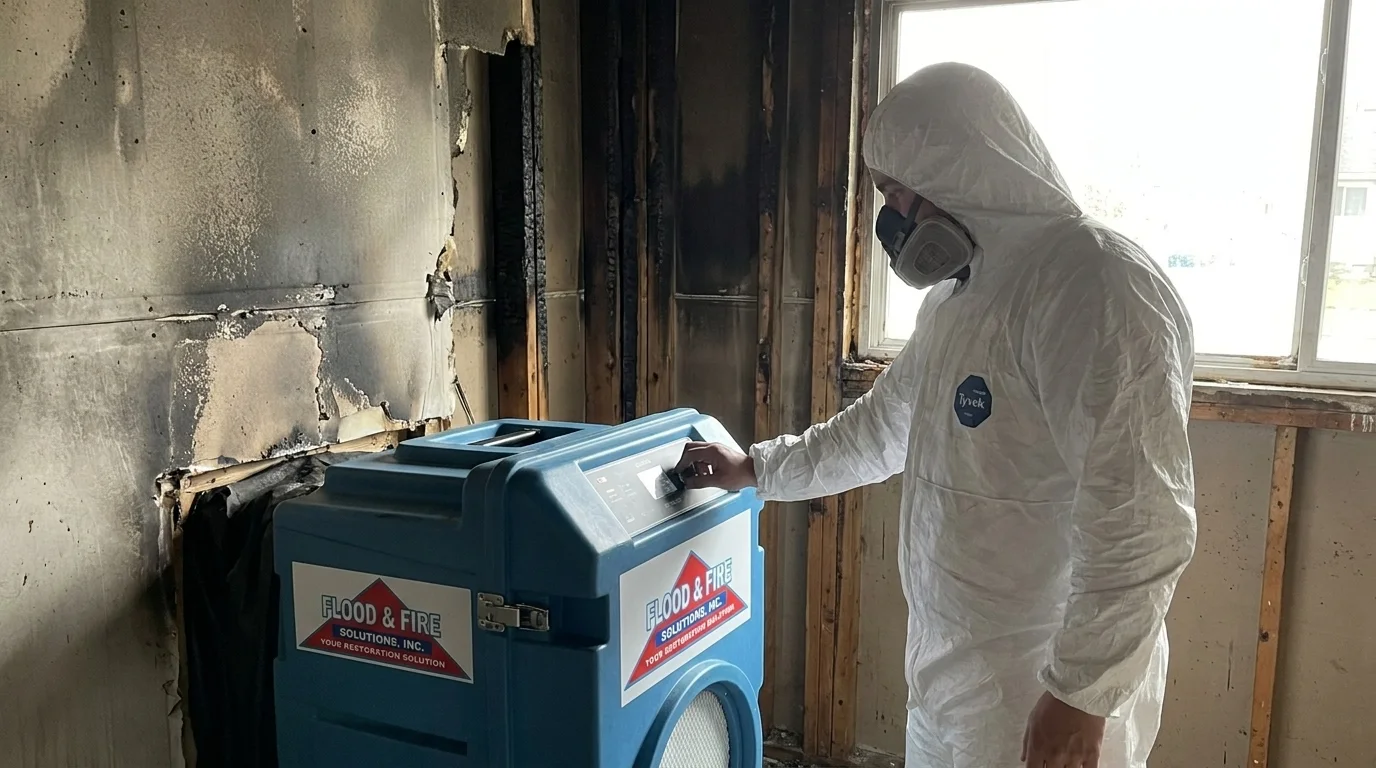
Emergency Fire Damage Restoration in Clinton Township
Emergency fire damage restoration in Clinton Township, MI. Insurance billing accepted. Call (586) 580-0197.
Our technicians are dispatched from our Macomb, MI headquarters and are typically on-site in Clinton Township within 60 minutes of your call.
Fire damage emergency in Clinton Township? Call now for emergency service. Our crew responds fast to secure the property and start the recovery.
Clinton Township’s housing stock tells the story in the aftermath of a fire. From the postwar ranch homes and brick colonials that fill neighborhoods across Macomb County to the newer subdivisions built in the 1990s and 2000s boom years, each construction era responds to fire and smoke differently. Flood Solutions Inc. has been working in communities like Clinton Township since 1996, and the combination of older wood-framed interiors, attached garages, and Michigan’s damp shoulder seasons creates a specific set of challenges once the fire trucks leave and the real restoration work begins.
Why Clinton Township Properties See Distinctive Fire Damage Patterns
The dominant housing stock across Clinton Township runs from postwar brick ranches to two-story colonials built through the 1970s and 1980s, with a significant wave of construction through the 1990s. That mix matters for fire damage in a few concrete ways.
Older homes often have plaster-and-lath wall systems rather than modern drywall. Smoke particulates and soot penetrate plaster differently, working into the porous surface and settling in cavities behind the lath. What looks like surface discoloration on a plaster wall can represent deep odor contamination that outlasts a simple wipe-down by weeks. Attached garages, common throughout Clinton Township’s residential neighborhoods, create a direct pathway for smoke and combustion byproducts to reach living spaces through shared walls and HVAC systems.
Michigan’s climate adds another layer. The region’s humidity in spring and fall means that water used in firefighting does not evaporate quickly. Structural materials stay wet longer, and when soot-laden moisture sits in wall cavities or under flooring, secondary mold growth can begin within 48 to 72 hours of the fire event. Restoration that addresses only the visible fire damage without accounting for moisture intrusion leaves a property vulnerable to a second round of damage.
Our Fire Damage Restoration Process in Clinton Township
The first step on any fire loss is a thorough assessment, not just of charred or visibly burned areas, but of the full smoke migration path. Smoke travels through HVAC ducts, rises into attic spaces, and settles into soft materials like carpeting and upholstered furniture far from the point of origin. We use air quality monitoring and thermal imaging alongside visual inspection to map where contamination has traveled.
Structural stabilization comes next when load-bearing elements have been compromised. In Clinton Township’s older colonials, roof trusses and floor joists are often dimensional lumber rather than engineered wood, which behaves differently under heat stress. We document structural conditions thoroughly, both for accurate repair scoping and for insurance carrier review.
Odor removal in fire damage is a process, not a single treatment. Thermal fogging, hydroxyl generation, and ozone application each address different odor compounds in different materials. Soot on hard surfaces requires specific chemical agents matched to the surface type, because the wrong cleaner can permanently set staining rather than lift it. Porous materials, including insulation, carpet padding, and some cabinetry, often require removal rather than cleaning once smoke has fully penetrated them.
Final reconstruction, handled by your rebuild contractor, brings the structure back to pre-loss condition, coordinating with local building requirements for any permitted work.
Reaching Clinton Township from Macomb
Flood Solutions Inc. operates out of Macomb, which positions the crew well for Clinton Township calls. Hall Road (M-59) and Groesbeck Highway are the primary corridors connecting Macomb to Clinton Township, and both routes run directly through the area without the congestion chokepoints that affect routes further south toward the Detroit metro core. For properties in the northern sections of Clinton Township near the Macomb Township border, the drive from our HQ is particularly direct.
When you call (586) 580-0197, the team can give you a realistic arrival estimate based on current conditions rather than a marketing figure.
Clinton Township Insurance Coordination
Fire losses almost always involve a homeowner’s insurance claim, and the documentation phase is where restoration outcomes are often won or lost. Carriers require detailed photo documentation, moisture readings, air quality data, and itemized scope of work before authorizing repair. We produce that documentation as a standard part of the assessment process, not as an add-on.
Clinton Township properties built before 1978 may also trigger lead paint protocols during reconstruction if fire damage requires disturbing painted surfaces. This is a code-driven requirement that affects the scope and cost of any permitted rebuild work, and it is worth discussing with your adjuster early in the claims process.
Local Note
One pattern specific to Clinton Township’s postwar brick ranches: the original interior walls in many of these homes were finished with a three-coat plaster system over metal lath rather than gypsum board. After a fire, the plaster itself may test structurally sound while the metal lath behind it has corroded from firefighting water and heat cycling. A wall that passes a visual inspection can still require full replacement once the lath condition is assessed. Skipping that step during restoration leads to callbacks months later when the plaster begins to separate. It is the kind of detail that only surfaces when you have worked in this housing stock long enough to know what to look for.
If you are dealing with fire or smoke damage anywhere in Clinton Township, call Flood Solutions Inc. at (586) 580-0197. The sooner the assessment begins, the more options remain open for salvaging materials and controlling the total scope of the loss.
Serving Clinton Township from our Macomb headquarters — ★ 4.4 · 35 Google reviews
“Such a great experience this team was so helpful. Got my basement cleaned up and made sure there was no damage to the walls or anything else. They handled everything so fast.” — Danielle, October 2025Read our reviews on Google →
Fire Damage Restoration in Clinton Township: Service Coverage
Frequently Asked Questions
How fast can you arrive for fire damage restoration in Clinton Township?
How quickly can Flood Solutions Inc. reach Clinton Township from its Macomb headquarters?
Clinton Township has a lot of older brick ranch homes. Does that construction type affect how fire and smoke damage is handled?
Does Michigan's climate create any specific risks after a fire in Clinton Township?
How does fire damage restoration interact with insurance claims for Clinton Township homeowners?
What does the smoke odor removal process actually involve, and how long does it take in a typical Clinton Township home?
Fire Damage Restoration response in Clinton Township
Most Clinton Township calls see a technician on-site within 60 minutes from our Macomb headquarters.
Nearby & Related
- Emergency Fire Damage Restoration in Macomb
- Restoration Services in Clinton Township
- Emergency Water Damage Restoration in Clinton Township
- Emergency Sewage Cleanup and Sanitization in Clinton Township
- Emergency Fire Damage Restoration in Chesterfield
- Emergency Fire Damage Restoration in Rochester Hills
- Contact Flood & Fire Solutions