
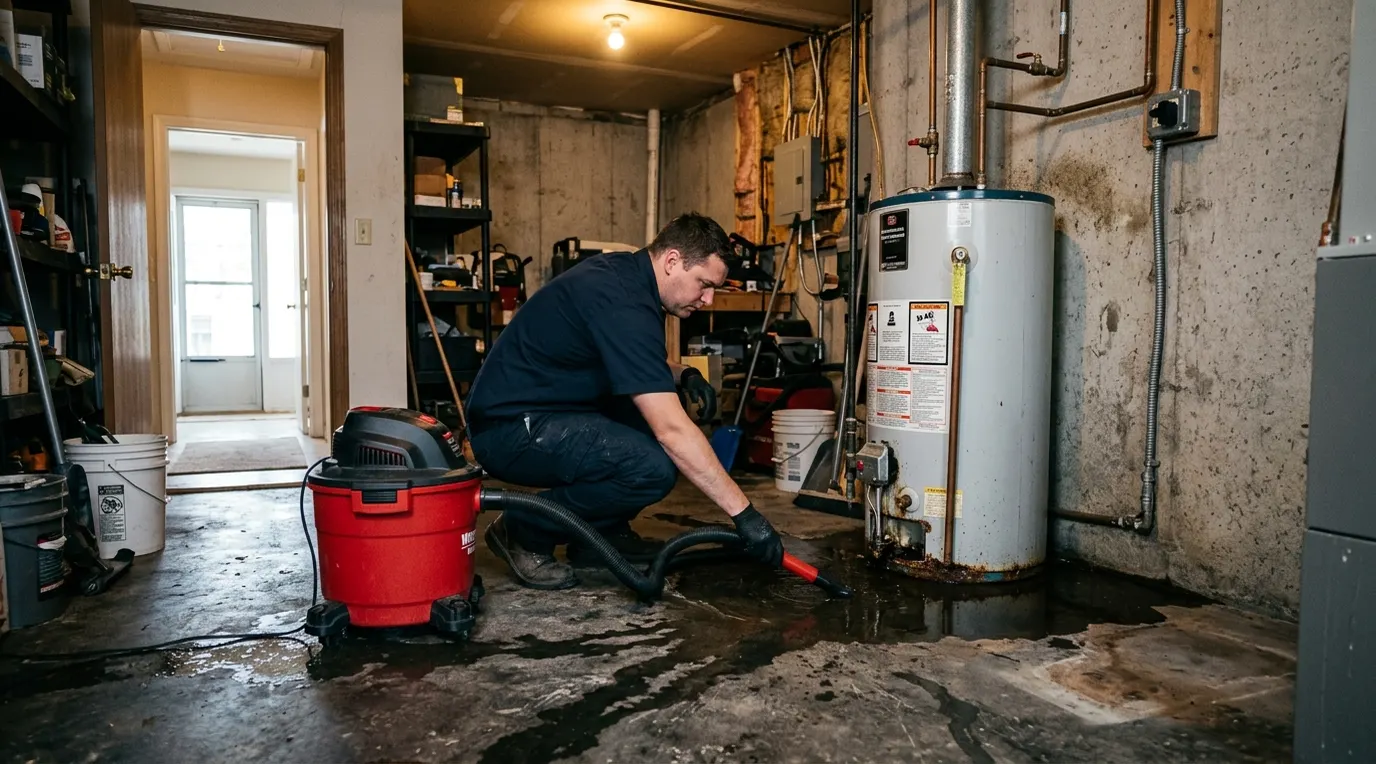
Emergency Water Heater Flood Cleanup in Macomb
Emergency water heater flood cleanup in Macomb and surrounding areas. Insurance billing accepted. Call (586) 580-0197.
Burst pipe or leak in Macomb? Call now for emergency service. Our crew responds fast to stop the water and start the cleanup.
A water heater that bursts or fails slowly can push dozens of gallons across a utility room floor before anyone notices the smell of mineral-laden water soaking into drywall or the soft give of a subfloor that has been wet for hours. Unlike a pipe burst that announces itself loudly, water heater leak damage often starts quiet, hidden behind the unit or under a drip pan that overflowed sometime overnight. By the time you find it, the water has already made decisions for you about what gets saved and what gets replaced.
What water heater flood cleanup actually involves
A failed water heater introduces what the industry classifies as Category 1 water, meaning it originates from a sanitary supply line and is considered clean at the point of release. That classification matters because it affects how aggressively materials need to be treated and whether porous contents can be dried in place or must be removed. The catch is that Category 1 water does not stay Category 1 indefinitely. Once it contacts a concrete slab, drywall paper, insulation, or a wood subfloor, it picks up contaminants and begins degrading in classification within hours.
The typical water heater sits in a utility closet, garage, or basement corner, often surrounded by drywall on two or three sides and flooring that runs under adjacent rooms. A 40- or 50-gallon tank that drains completely can saturate wall cavities several feet from the unit itself. Thermal imaging and calibrated moisture meters are the only reliable way to find where the water actually traveled, because surface readings at the baseboards frequently understate how far moisture has wicked upward through drywall or laterally under vinyl plank and laminate.
Drying timeline depends on materials affected. Open concrete in a garage may reach drying goals in two to three days with adequate airflow. A finished basement with carpet, pad, and drywall on wood framing typically requires five to seven days of continuous drying equipment operation, with daily moisture readings to confirm the drying curve is moving in the right direction.
Our process
-
Arrival and source confirmation. Before any extraction begins, the failed water heater is confirmed off and the supply valve is closed. If the unit is still connected and leaking, stopping the source takes priority over everything else.
-
Thermal imaging and moisture mapping. A technician walks the full affected area with a thermal camera and pin-type or pinless moisture meters, logging readings at the unit location, along every wall that shares the space, and in adjacent rooms where water may have traveled under doors or through shared wall cavities. This map becomes the baseline the drying crew works against each day.
-
Water extraction. Standing water is removed with a truck-mounted or portable extractor. Carpet and pad, if present, are assessed for salvageability. Wet insulation behind drywall is almost never salvageable and is documented for removal rather than in-place drying.
-
Structural drying with calibrated equipment. Commercial-grade desiccant or refrigerant dehumidifiers and high-velocity air movers are positioned to create a controlled drying chamber. Equipment placement follows the affected footprint from the moisture map, not just the visible wet area. Readings are logged at each visit to document the drying curve for the insurance file.
-
Final clearance and documentation. When all monitored materials reach target moisture content, a final moisture map is completed and compared to the baseline. The completed documentation, including daily logs and equipment records, is provided to the homeowner and submitted with the insurance claim.
What separates a good water heater flood cleanup response from a bad one
The most common mistake in water heater leak damage cleanup is scoping the job by what is visibly wet rather than by where the water actually went. Laminate and vinyl plank flooring trap water underneath and can appear completely dry on the surface while the subfloor below is reading well above acceptable moisture content. A technician who does not pull readings under the flooring or inside wall cavities will close out a job that still has active moisture, and that moisture will feed mold growth within days to weeks.
A second common failure is under-deploying drying equipment to reduce cost. Structural drying is not linear. Fewer machines do not simply mean a longer dry time; they can mean the drying curve stalls entirely in materials with high mass, like concrete block or thick subfloor assemblies. Insurance adjusters reviewing a claim after secondary mold damage will look at whether equipment deployment matched the affected square footage and material types documented at the loss.
Good operators also document the water heater itself, including the age, model, and visible failure point, because homeowners insurance coverage for the resulting water damage often hinges on whether the failure was sudden and accidental versus a slow leak that went unaddressed.
What does water heater flood cleanup cost?
Typical costs for water heater leak damage cleanup depend heavily on how long the water sat, what materials were affected, and whether adjacent rooms were involved. Most homeowners pay somewhere in the following ranges for professional extraction and structural drying:
| Scenario | Typical range |
|---|---|
| Small utility room, clean water, concrete floor | $800 - $2,000 |
| Utility closet with drywall, vinyl flooring affected | $1,500 - $3,500 |
| Finished basement room, carpet and drywall involved | $3,000 - $6,500 |
| Multiple adjacent rooms, subfloor replacement needed | $5,500 - $12,000 |
| Mold remediation required due to delayed discovery | $2,000 - $8,000 additional |
These are typical industry figures based on scope and materials; they are not quotes from Flood Solutions inc. Every loss is different, and Flood Solutions inc provides a written scope of work before any work begins. Homeowners insurance typically covers sudden and accidental water heater failures, including the resulting water damage to structure and contents, though the water heater itself is generally excluded from the claim.
Seasonal and regional considerations
Macomb County’s winters create a specific risk pattern for water heaters. Units in unheated garages or crawl spaces work harder during cold snaps, and the thermal stress on aging tanks accelerates corrosion at the base and around the pressure relief valve. Failures in January and February are common, and a leak that starts overnight in a garage that drops below freezing can freeze at the perimeter while the center remains liquid, complicating extraction and hiding the full extent of saturation until the thaw.
The clay-heavy soils common across Macomb County also mean that basements and slab-on-grade utility rooms can retain ground moisture independently of a water heater event. A technician reading moisture in a basement needs to distinguish between water heater leak damage and ambient ground moisture intrusion, because the two require different responses.
Service area
Flood Solutions inc serves Macomb and the surrounding communities throughout Macomb County, including Sterling Heights, Clinton Township, Shelby Township, Chesterfield Township, and Warren. The service-area pages for each city link back here for the full technical detail on water heater flood cleanup. If you are outside these areas, call (586) 580-0197 and the team can advise on coverage.
If you are standing in a wet utility room right now, the next step is a moisture assessment, not a guess. Call Flood Solutions inc at (586) 580-0197 to schedule your water heater flood cleanup and moisture mapping so you know exactly what is wet, what needs to come out, and what can be saved.
Services We Handle
- Flood Cleanup
Frequently Asked Questions
Does homeowners insurance cover water heater leak damage?
My water heater leak was slow and I am not sure how long it has been going. Does that change the cleanup?
Can the flooring be dried in place, or does it have to come up?
How do I know when the structural drying is actually finished?
The water heater is in my garage and the water ran under the wall into the adjacent room. Do both spaces need to be treated?
Looking for the best water-heater-flood-cleanup company in Macomb?
Flood Solutions inc provides water-heater-flood-cleanup in Macomb, MI and the surrounding area, and has served local property owners since 1996. Customers rate us 4.4 out of 5 stars across 35 Google reviews. We answer calls 24/7 — call (586) 580-0197 for immediate help.
Need water-heater-flood-cleanup now?
We respond 24/7 across Macomb and surrounding MI cities.
Related Coverage
- Our Restoration Services
- Contact Flood & Fire Solutions
- Emergency Water Heater Flood Cleanup in Chesterfield
- Emergency Water Heater Flood Cleanup in Clinton Township
- Emergency Water Heater Flood Cleanup in Rochester Hills
- Emergency Water Heater Flood Cleanup in Shelby Township
- Emergency Water Heater Flood Cleanup in Sterling Heights
- Emergency Water Heater Flood Cleanup in Troy
- Emergency Water Heater Flood Cleanup in Utica
- Emergency Water Heater Flood Cleanup in Warren