
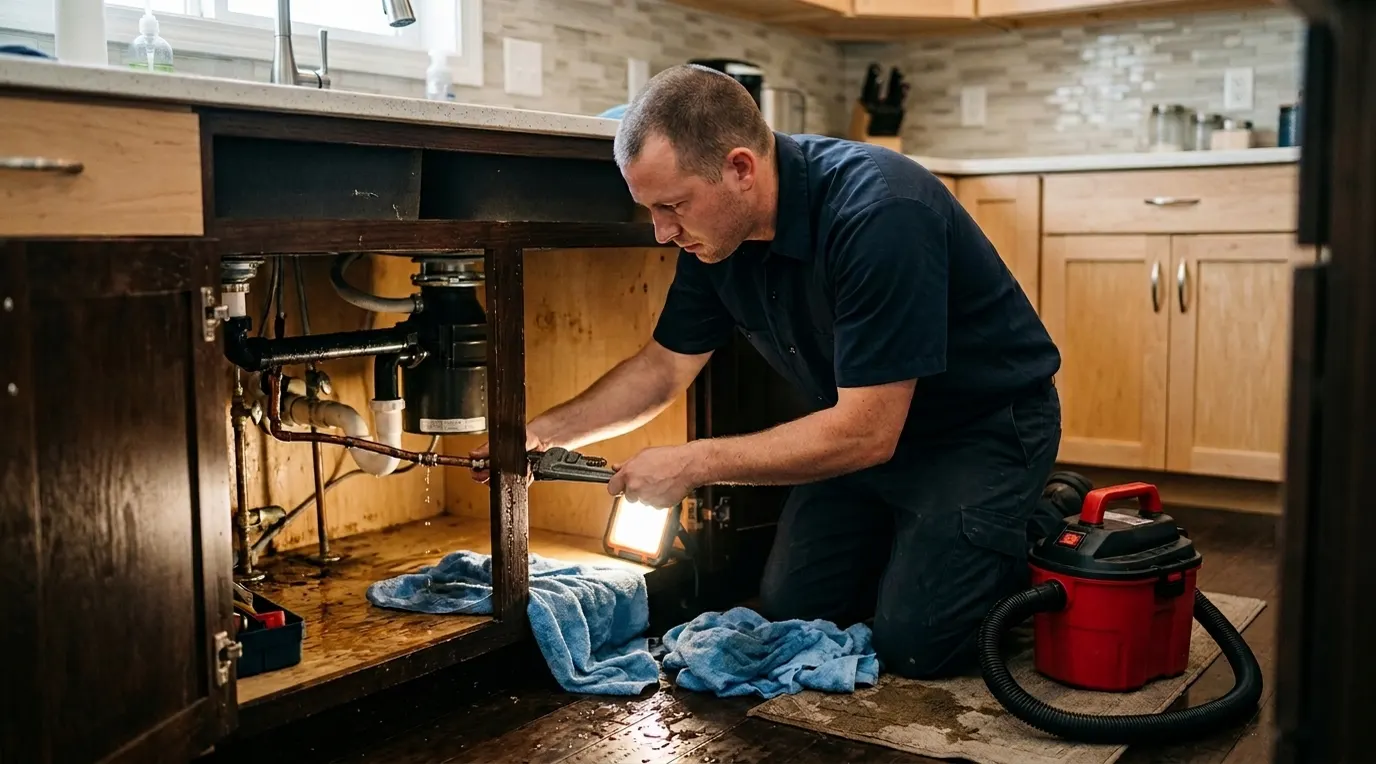
Emergency Burst Pipe Cleanup and Repair in Macomb
Emergency burst pipe cleanup and repair in Macomb and surrounding areas. Insurance billing accepted. Call (586) 580-0197.
Burst pipe or leak in Macomb? Call now for emergency service. Our crew responds fast to stop the water and start the cleanup.
A burst pipe does not announce itself slowly. One moment everything is normal; the next, water is sheeting down a wall, pooling across hardwood, or soaking through drywall before you have found the shutoff valve. The first hour after a pipe break determines how much of your home you save. Water from a supply line moves fast, wicks into framing and insulation within minutes, and begins softening subfloor adhesives and paper-faced drywall long before the surface feels wet to the touch.
What burst pipe cleanup actually involves
Burst pipe cleanup is not just removing standing water. The visible puddle is the smallest part of the problem. Supply-line water is typically clean at the source (Category 1), but it picks up contaminants as it travels through finished materials, and any water that has been sitting more than 24 to 48 hours begins migrating toward Category 2 status regardless of its origin.
The real work is what happens inside the assembly: water trapped behind baseboard, saturating the bottom plate of a stud wall, or wicking up into OSB subfloor. Thermal imaging cameras and calibrated moisture meters reveal saturation that looks and feels dry at the surface. Without that mapping step, crews pull equipment too early, moisture redistributes, and mold colonization can begin in wall cavities within 48 to 72 hours of the initial event.
Equipment on a properly scoped burst pipe job typically includes truck-mounted or portable extraction units, desiccant or refrigerant dehumidifiers sized to the affected cubic footage, axial and centrifugal air movers positioned to create a drying vortex across wet assemblies, and in-wall drying panels or cavity drying systems when the framing is saturated but the drywall can be saved.
Timeline: most residential burst pipe losses with contained water damage dry to IICRC S500 standard in three to five days of continuous equipment operation, with daily moisture readings confirming progress. Losses involving structural framing, concrete slab, or multi-layer flooring assemblies take longer.
Our process
-
Locate and isolate the source. Before extraction begins, the broken line is identified and confirmed isolated. If the main is still feeding pressure to a failed fitting, extraction is futile. We coordinate with the homeowner on shutoff location and, when needed, with the local utility.
-
Moisture mapping and category assessment. Using thermal imaging and pin-type and pinless moisture meters, we document the full perimeter of saturation, including areas not visibly wet. This map drives every subsequent decision and becomes part of the insurance claim file.
-
Controlled demolition and extraction. Standing water is extracted first. Then any drywall, flooring, or insulation that is beyond drying thresholds is removed in a controlled manner to expose wet framing and allow airflow. Flood cuts are made at the appropriate height to preserve as much material as possible while eliminating trapped moisture reservoirs.
-
Structural drying with daily monitoring. Dehumidifiers and air movers run continuously. Moisture readings are logged at each monitoring point every 24 hours. Equipment is not removed until readings reach dry standard across all affected assemblies, not just the surface.
-
Final documentation and scope for reconstruction. Once drying is confirmed, a written scope of affected materials is provided. This document details what was removed, what dried in place, and what requires replacement, and it goes directly to your insurance adjuster or contractor for the rebuild phase.
What separates a good burst pipe response from a bad one
The most common failure in burst pipe cleanup is incomplete moisture mapping. A crew that extracts standing water, runs fans for two days, and calls the job dry has almost certainly left moisture in the wall cavity, under the flooring, or in the subfloor. That hidden moisture is where mold starts.
A second common mistake is misclassifying the water category after a delay. Water from a copper supply line is clean at the break point, but if it has been sitting in a finished basement for 12 hours, soaking through carpet pad and contacting the concrete slab, the contamination profile has changed. Treating it as Category 1 at that point means skipping antimicrobial treatment steps that insurance adjusters expect.
Insurance adjusters reviewing burst pipe claims look for a moisture log with dated readings at each monitoring location, documentation of the water source and category determination, a photo record of conditions before, during, and after demolition, and a line-item scope that matches XACTIMATE or comparable estimating standards. A claim file without these elements is harder to approve and slower to close.
What does burst pipe cleanup cost?
Typical costs for burst pipe cleanup depend on the size of the affected area, the number of building assemblies involved, and how long the water was present before extraction began. Most homeowners pay somewhere in these ranges for the mitigation phase alone, before any reconstruction:
| Scenario | Typical range |
|---|---|
| Single room, clean water, caught quickly | $1,200 - $3,500 |
| Two to three rooms, minor wall saturation | $3,500 - $7,000 |
| Multi-room loss with subfloor involvement | $6,500 - $14,000 |
| Finished basement, full extraction and drying | $8,000 - $18,000 |
| Slab leak with flooring removal and drying | $5,000 - $12,000 |
These are typical industry figures based on scope and region; they are not quotes. Every loss is different, and Flood Solutions inc provides a written scope before any work begins. Homeowners insurance generally covers sudden and accidental pipe breaks, including mitigation and reconstruction costs, though coverage for the pipe repair itself varies by policy.
Seasonal and regional considerations
Macomb County’s freeze-thaw pattern is one of the most reliable predictors of burst pipe volume in southeast Michigan. Pipes in exterior walls, crawl spaces, and unheated garages are most vulnerable during rapid temperature drops in January and February, and again during the thaw cycle when ice blockages release pressure suddenly. Homes built in the mid-century expansion of Macomb Township and Sterling Heights often have copper supply lines that are now decades old; work-hardened copper becomes brittle and more susceptible to freeze fractures than newer PEX installations. If your home has not had a plumbing inspection since the original installation, a pipe failure during a cold snap is not unlikely.
The spring thaw also brings a secondary risk: ground movement and hydrostatic pressure that can stress older cast-iron or galvanized lines at their joints, producing slow leaks that go undetected until a finished ceiling shows a stain.
Service area
Flood Solutions inc handles burst pipe cleanup and water line break response throughout Macomb County, including Macomb Township, Sterling Heights, Clinton Township, Shelby Township, Warren, and the surrounding communities. The city-specific pages for each area link back here for full process and technical detail.
If you are standing in a wet room right now, call (586) 580-0197 to speak with someone who can walk you through immediate steps and schedule your moisture assessment.
Services We Handle
- Burst Pipe Cleanup
Frequently Asked Questions
Does homeowners insurance cover burst pipe cleanup and water damage?
How long does structural drying take after a pipe break?
What should I do immediately after a pipe bursts, before help arrives?
Why does it matter how quickly extraction starts after a pipe break?
Can drywall and flooring be dried in place, or does everything have to come out?
Looking for the best burst-pipe-repair company in Macomb?
Flood Solutions inc provides burst-pipe-repair in Macomb, MI and the surrounding area, and has served local property owners since 1996. Customers rate us 4.4 out of 5 stars across 35 Google reviews. We answer calls 24/7 — call (586) 580-0197 for immediate help.
Need burst-pipe-repair now?
We respond 24/7 across Macomb and surrounding MI cities.
Related Coverage
- Our Restoration Services
- Contact Flood & Fire Solutions
- Emergency Burst Pipe Cleanup and Repair in Chesterfield
- Emergency Burst Pipe Cleanup and Repair in Clinton Township
- Emergency Burst Pipe Cleanup and Repair in Rochester Hills
- Emergency Burst Pipe Cleanup and Repair in Shelby Township
- Emergency Burst Pipe Cleanup and Repair in Sterling Heights
- Emergency Burst Pipe Cleanup and Repair in Troy
- Emergency Burst Pipe Cleanup and Repair in Utica
- Emergency Burst Pipe Cleanup and Repair in Warren