
Content Recovery in Troy
Content recovery in Troy, MI. Insurance billing accepted. Call (586) 580-0197.
Our technicians are dispatched from our Macomb, MI headquarters and are typically on-site in Troy within 60 minutes of your call.
When water reaches the family room carpet or smoke settles into upholstery, the structure of a house is only half the loss. The furniture, electronics, photo albums, and file boxes sitting in a Troy basement or family room need their own recovery plan, one that moves fast enough to stop mold from colonizing fabric and wood but careful enough to save what can actually be saved. Content recovery in Troy carries its own wrinkle: a huge share of the housing stock here was built during the city’s big growth years in the 1960s through 1980s, and those homes were finished with materials, particleboard cabinetry, veneer furniture, wall-to-wall carpet pads, that behave very differently under water than the plaster and hardwood common in older Michigan cities.
Why Troy Homes See Content Loss From Water and Smoke
Troy sits on the clay-heavy till common across Oakland County, and clay doesn’t drain the way sandy or loamy soil does. After a heavy spring rain or a fast snowmelt, water can sit against foundation walls longer than homeowners expect, which is exactly the condition that pushes moisture into finished basements where families store furniture, holiday decorations, and file cabinets. Add in Michigan’s freeze-thaw winters, which stress foundation joints and sump systems over decades, and basement seepage becomes one of the more common reasons Troy homeowners call about damaged belongings rather than damaged structure. Furnace and water heater failures in finished lower levels cause the same problem in reverse: sudden, contained flooding that soaks everything stored nearby before anyone notices.
Our Content Recovery Process in Troy
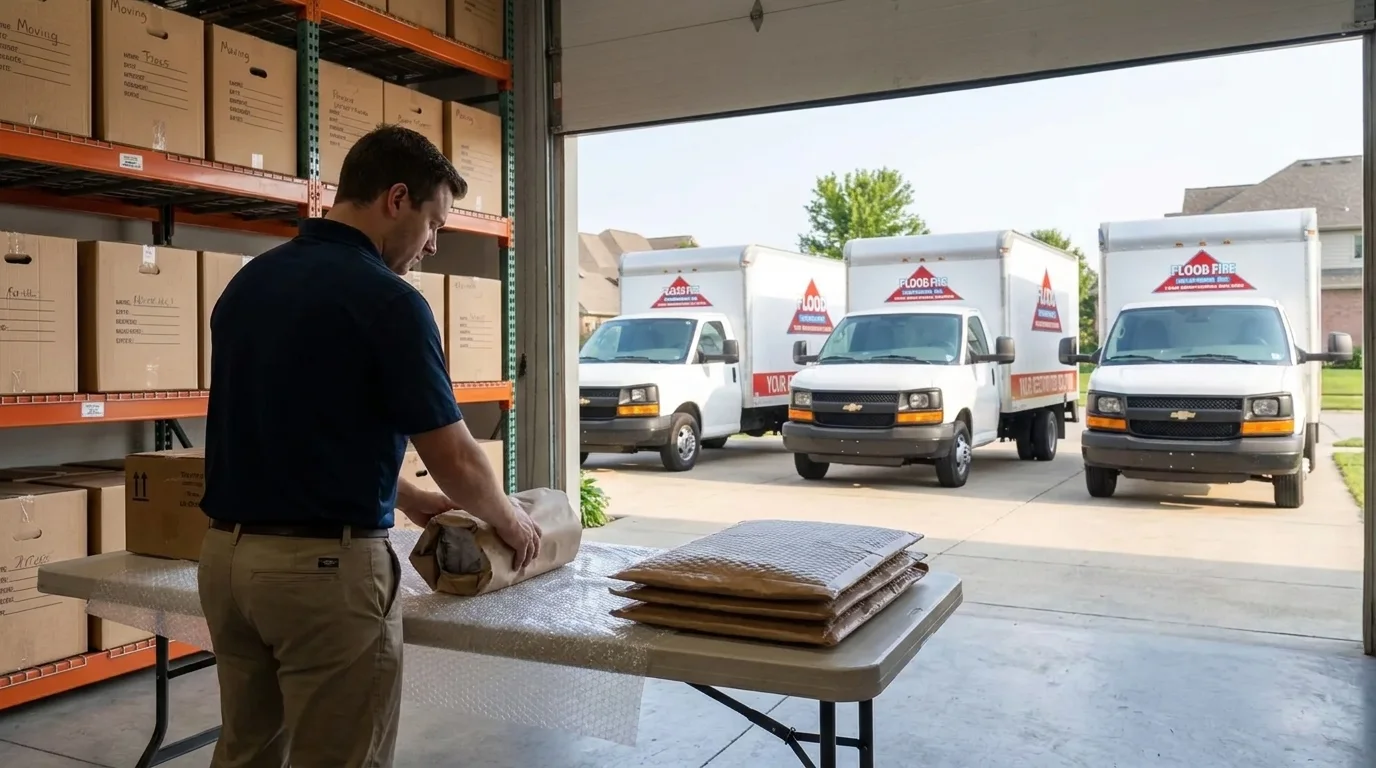
The first visit is about triage, not packing everything into boxes. We separate items into what can be cleaned and dried on-site, what needs to travel to a dedicated drying and cleaning facility, and what’s beyond saving, then document all three categories with photos before anything moves. Upholstered furniture and electronics typically leave the property for specialized treatment; hard-surface furniture, most textiles, and paper goods can often be stabilized in place if we reach them before the 24 to 48 hour window where mold and odor set in. For Troy’s mid-century colonials and ranches, we pay close attention to particleboard and veneer furniture pieces, common in finished basements built out in the 1970s and 80s, because they swell and delaminate faster than solid wood and often can’t be salvaged the way an older, solid-wood piece can.
Every item that leaves the house gets logged into a content inventory with condition notes and photos, which becomes the backbone of the insurance claim later. That inventory matters more than most homeowners realize when a claim covers dozens of individual items rather than one square footage number.
Troy Insurance Coordination for Content Recovery
Content claims tend to be more paperwork-heavy than structural claims because carriers want an itemized accounting of loss rather than a single line item. We build that documentation as we go, room by room, so the adjuster is working from the same inventory we used during the pack-out instead of a homeowner’s after-the-fact memory. For Troy properties in subdivisions with HOA governance, particularly newer developments where exterior storage sheds or garage buildouts hold overflow belongings, we also note any HOA-specific storage or disposal rules before hauling anything offsite, since some associations require notice before large item removal from a property.
Local note
One detail that catches Troy homeowners off guard: basements finished after the original build, which is common in this city’s older ranch and colonial stock, often have carpet laid directly over a slab without a proper vapor barrier. When that carpet gets wet, the pad wicks moisture into the subfloor edges and baseboards far faster than a standard finished space, which means furniture and boxes sitting near the perimeter walls are usually wetter than they look on first inspection. We check those edge zones specifically rather than relying on how dry the center of the room feels underfoot.
If water or smoke has reached your belongings, the clock that matters most is the one before mold and odor become permanent. Flood Solutions inc has worked Michigan losses since 1996, and for Troy homeowners that means a team that understands how this city’s basements, soil, and building stock behave once water gets in. Call (586) 580-0197 to get a content recovery assessment started and a documented inventory building from the first visit.
Serving Troy from our Macomb headquarters — ★ 4.4 · 35 Google reviews
“Very knowledgeable and friendly employees. I had a flooded crawl space that I couldn't take care of myself. But Louis and his crew talked me through the whole process and then finished the job quickly and thoroughly.” — Chuck, October 2025Read our reviews on Google →
Content Recovery in Troy: Service Coverage
Frequently Asked Questions
How fast can you arrive for content recovery in Troy?
Are finished basements in Troy's older ranch homes more prone to content damage?
Does Troy's clay soil affect how often content recovery is needed after storms?
What happens to particleboard or veneer furniture from a Troy basement flood?
Do Troy HOA communities have rules about removing damaged belongings?
How does content recovery documentation help a Troy insurance claim?
Content Recovery response in Troy
Most Troy calls see a technician on-site within 60 minutes from our Macomb headquarters.