
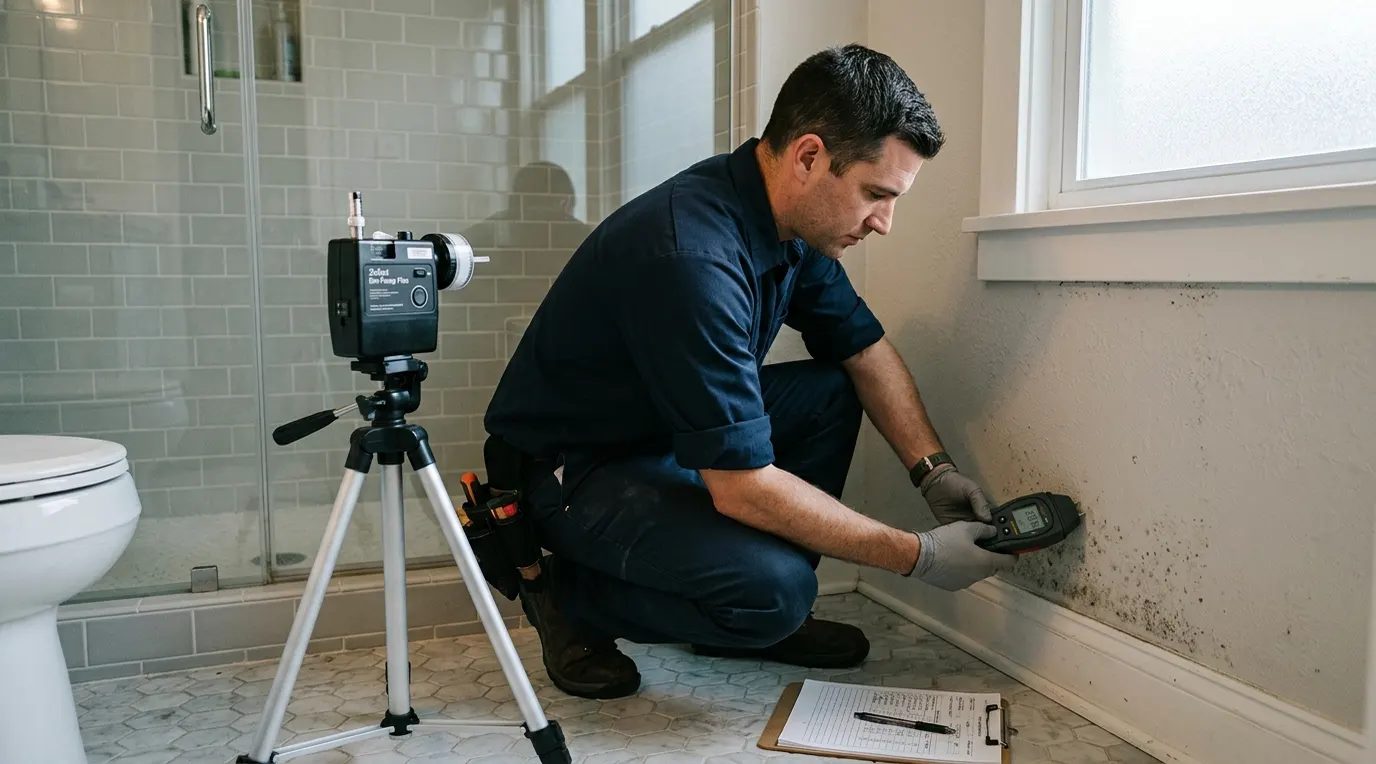
Mold Inspection and Testing in Sterling Heights
Mold inspection and testing in Sterling Heights, MI. Insurance billing accepted. Call (586) 580-0197.
Our technicians are dispatched from our Macomb, MI headquarters and are typically on-site in Sterling Heights within 60 minutes of your call.
Sterling Heights sits in Macomb County’s clay-heavy soil belt, where poor drainage and freeze-thaw cycles push moisture into basements and crawl spaces with quiet persistence. When that moisture lingers, mold doesn’t wait long to follow. A surface that looks dry after a slow leak or a backed-up sump can still carry active spore colonies behind drywall or under subfloor material, and the only way to know what you’re actually dealing with is a professional mold inspection and testing protocol, not a visual guess.
Why Sterling Heights Properties See Mold Issues
Macomb County’s clay-dominant soil doesn’t drain the way sandy or loam-based soils do. After heavy spring rains or a hard winter thaw, groundwater pressure against foundation walls is a consistent problem throughout Sterling Heights. Homes built in the post-war suburban expansion of the 1950s and 1960s, which make up a large portion of the city’s residential stock, often have block-wall basements with aging parging and mortar joints that have had decades to develop small cracks. Water doesn’t need a large opening to create the sustained humidity that mold requires.
Beyond foundation seepage, Sterling Heights also sees mold problems tied to HVAC systems. Many homes in the area run forced-air systems with ductwork that passes through unconditioned spaces like attics and rim joist areas. Condensation inside those ducts, especially during Michigan’s humid summers, can seed mold growth that then circulates through the entire living space. Indoor air quality testing is often the first indication that something is wrong before any visible growth appears.
Our Mold Inspection and Testing Process in Sterling Heights
A thorough mold assessment starts before any sample is collected. The inspection phase involves a full walkthrough of the property, including basement, crawl space, attic, and any areas with a history of water intrusion. Moisture meters and thermal imaging help identify elevated readings in wall cavities and under flooring where surface conditions can be misleading.
Once problem areas are identified, air and surface sampling follows. Air samples capture the spore count and species composition in different zones of the home, giving a picture of indoor air quality relative to an outdoor baseline. Surface samples from suspect materials confirm whether visible discoloration is mold or something else entirely. All samples are sent to an accredited third-party laboratory for analysis.
The written report you receive after testing identifies the species present, the concentration levels, and the affected zones. That documentation is specific enough to guide remediation scope and is formatted to support insurance claims and, where applicable, real estate disclosure requirements.
Reaching Sterling Heights from Macomb
Flood Solutions inc is based in Macomb, which puts Sterling Heights well within a short drive via Hall Road or M-59 depending on where in the city your property is located. The northern and eastern sections of Sterling Heights are particularly close to our base of operations, which means scheduling is straightforward and there’s no need to wait for a crew traveling from a distant metro hub.
For properties in the western portions of the city closer to the Van Dyke corridor, routing through 15 Mile or 18 Mile Road keeps travel time minimal. When you call (586) 580-0197, the team can give you a realistic arrival window based on current scheduling.
What Mold Testing Tells You That a Visual Check Cannot
Mold species matter. Cladosporium, found commonly in Michigan homes, behaves differently than Stachybotrys chartarum, which requires sustained water saturation to establish and is associated with more serious indoor air quality concerns. A visual inspection alone cannot distinguish between species, and it cannot detect elevated airborne spore counts in rooms that appear clean. Laboratory analysis of collected samples gives you that specificity.
For homeowners preparing to sell, or buyers conducting due diligence on a Sterling Heights property, a documented mold assessment with lab results carries weight that a contractor’s verbal opinion does not. It creates a paper trail that protects both parties.
Local Note
One pattern that comes up repeatedly in Sterling Heights homes from the 1960s and 1970s is mold growth concentrated around the band joist, the horizontal framing member that sits at the top of the foundation wall. Builders of that era commonly left this area uninsulated, and in Michigan’s climate, it becomes a condensation magnet during cold months. Homeowners often don’t think to look there because it’s tucked behind finished basement walls or obscured by storage. During a mold inspection in Sterling Heights, that zone gets specific attention, because finding mold there early is far less disruptive than finding it after a finished basement renovation has enclosed it.
Serving Sterling Heights from our Macomb headquarters — ★ 4.4 · 35 Google reviews
“I have utilized Flood and Fire solutions twice for my home. I would highly recommend them and will always use them for any needs in the future if I unfortunately have the need. Crew worked very hard, efficiently, and professionally. Luis and his crew were very impressive and take pride in what they…” — Angela, February 2026Read our reviews on Google →
mold-inspection-testing in Sterling Heights: Service Coverage
Frequently Asked Questions
How fast can you arrive for mold-inspection-testing in Sterling Heights?
How does Sterling Heights' clay soil affect mold risk in my home?
Are older Sterling Heights homes more likely to have hidden mold behind finished walls?
What does a mold air quality test actually measure in a Sterling Heights home?
Will mold inspection findings affect a Sterling Heights real estate transaction?
How long does a mold inspection and testing visit take for a typical Sterling Heights house?
Will my homeowners insurance cover mold-inspection-testing in Sterling Heights?
mold-inspection-testing response in Sterling Heights
Most Sterling Heights calls see a technician on-site within 60 minutes from our Macomb headquarters.